




The Oxford Dictionary of Architecture: third edition
The Oxford Dictionary of Architecture: third edition, James Stevens Curl and Susan Wilson, Oxford University Press, 2015, ISBN 978 0 199674 98 5. 1,040 pages, 260 line drawings, hardback.
The success of this dictionary may be judged from its reaching a third edition in the 16 years since it first appeared. The 6,000 entries at which it now stands include new contributions on landscape architecture by Susan Wilson that make the third edition different from the two previous ones. Professor Stevens Curl, the main author, explains the circumstances of the book’s production in his two prefaces that introduce the new edition.
All planning offices except the most scrupulously ‘paper-free’ contain a bookshelf. Most of these have random accumulations of books and pamphlets. In places where conservation is practised, they are likely also to have a copy of Charles Mynor’s Listed Buildings, Conservation Areas and Monuments. The new dictionary is recommended as a useful addition to these workplace stalwarts. It is also worth considering for home use or for library-building in public places. It is slightly too bulky for the pocket but will fit gracefully on to all shelves.
It contains definitions of most built form and drawings by Stevens Curl himself of the parts that need more explaining. He is an accomplished artist and draughtsman. Main materials (such as granite, limestone and mortar) are here together with much useful terminology on carpentry and bricks. Architects (British, Irish, European and American in the main but not exclusively) are here with their dates, full names and some comments, with a geographical spread reaching back far into the past. Individuals still at work (such as Piano, Rogers and Foster, bracketed under the entry for ‘High Tech’) feature with many 20th century architects and their main works. Individual sites or locations are not here unless their names imply a building type (such as Kremlin or pyramid) or architectural feature (such as Venetian blind).
Concepts, movements and styles are here in plenty. These draw Stevens Curl out of his academic reserve. He comments acutely on the debates around ‘International Modern’ during the long 20th century, at this point introducing critics and scholars (such as Colvin, Betjeman, Pevsner and Summerson). Stevens Curl has written definitively on Victorian churches and cemeteries, Georgian Ireland, and London spas and pleasure grounds. His inclinations and his sympathies obviously lie here, yet he deals efficiently with the contemporary world. The new dictionary supplements existing textbooks or the internet for conservationists or other users but does not pretend to be a substitute for them.
Over 100 pages of bibliography offer a goldmine of learning and compilation (three different William Robinsons, for example), and valuable material on landscape (such as the entry on ‘Picturesque’). The sites covered represent more than any lifetime could encompass, so it is not surprising that small errors can creep in. Of the three entries for ‘Richardson’, the one for Henry Hobson Richardson (1838-86) concludes with the ‘demolition’ of ‘Lululand’ near Watford. This former country house is Grade II* listed, and the fragment of it that survives has been incorporated into a new and carefully designed block of flats.
Written with considerable wit as well as great scholarship, this is an indispensable book of reference.
This article originally appeared as ‘A is for architecture’ in Context 140, published by the Institute of Historic Building Conservation (IHBC) in July 2015.It was written by Graham Tite, conservation officer working under contract.
--Institute of Historic Building Conservation
Related articles on Designing Buildings
IHBC NewsBlog
IHBC sponsors Gardens Trust event 23-4 Sept 2026
.jpeg)
'Learning from the Past, Shaping the Future’ takes place in Milton Keynes
Renovations to Frank Lloyd Wright's Fallingwater complete
.jpg)
World Heritage Preserved project opens house for tours again
Shakespeare Birthplace Trust places Hall's Croft on HAR Register
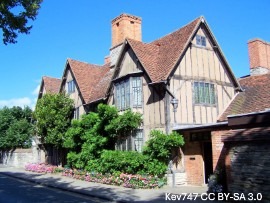
Stratford-upon-Avon home of Shakespeare's daughter is 'At Risk'
Lady Grange’s House repaired on St Kilda
.jpg)
National Trust for Scotland repairs stone cleit with link to famous island resident
Griff Rhys Jones on BBC Radio 4 Today programme
,_Green_Lane,_Derby.jpg)
The Victorian Society’s President unveiled its latest Top Ten Endangered Buildings 2026.
Need a MATE? Book your place now.
IHBC offers free webinars on applying for IHBC accreditation (Full & Associate).
UK Stained Glass Repository finds windows new homes
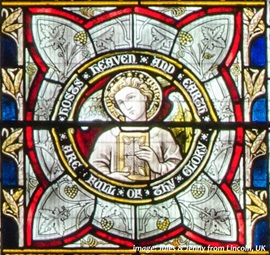
How are stained glass windows are rescued, stored and repurposed?
APPGEBE report sets high aims for quality
'Government must not sacrifice quality in drive to build 1.5m homes'
New measures protect Historic Shipwrecks from heritage crime

Underwater cultural heritage benefits from new HE guidance
How could the City of London skyline look in 6 years' time?

Visualisation shows approved planning applications as completed buildings
National Trust for Scotland calls for VAT cuts
Heritage neglect is encouraged by current policies
IHBC's 'Context' Issue 186 features Industrial Heritage
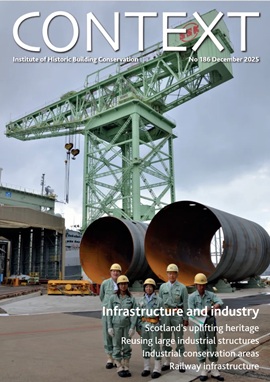
IHBC's members' journal reports on the challenges of conserving infrastructure
Book now for IHBC Annual School 2026

IHBC Annual School is taking place 18-20 June 2026 in Newcastle
RICHeS Research Infrastructure offers ‘Full Access Fund Call’
RICHeS offers a ‘Help’ webinar on 11 March
Latest IHBC Issue of Context features Roofing
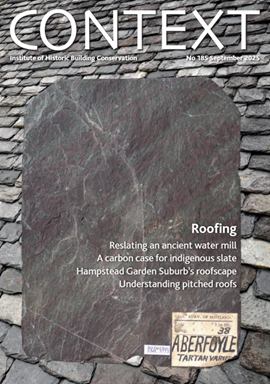
Articles range from slate to pitched roofs, and carbon impact to solar generation to roofscapes
Three reasons not to demolish Edinburgh’s Argyle House

Should 'Edinburgh's ugliest building' be saved?
IHBC’s 2025 Parliamentary Briefing...from Crafts in Crisis to Rubbish Retrofit
IHBC launches research-led ‘5 Commitments to Help Heritage Skills in Conservation’
How RDSAP 10.2 impacts EPC assessments in traditional buildings

Energy performance certificates (EPCs) tell us how energy efficient our buildings are, but the way these certificates are generated has changed.